Defilade Cover System Explained: How Soldier AI Uses Ground
How Defilade’s cover system works: geometry-aware soldiers, posture, blind fire, trenches, vehicles, grenade dives and the difference between cover and concealment.
Primary search intent
Defilade cover system
On this page +
This guide describes the cover system RBGames has announced and demonstrated. It is not a tested breakdown of hidden accuracy modifiers. No public cover-value table exists, and we will not invent one.
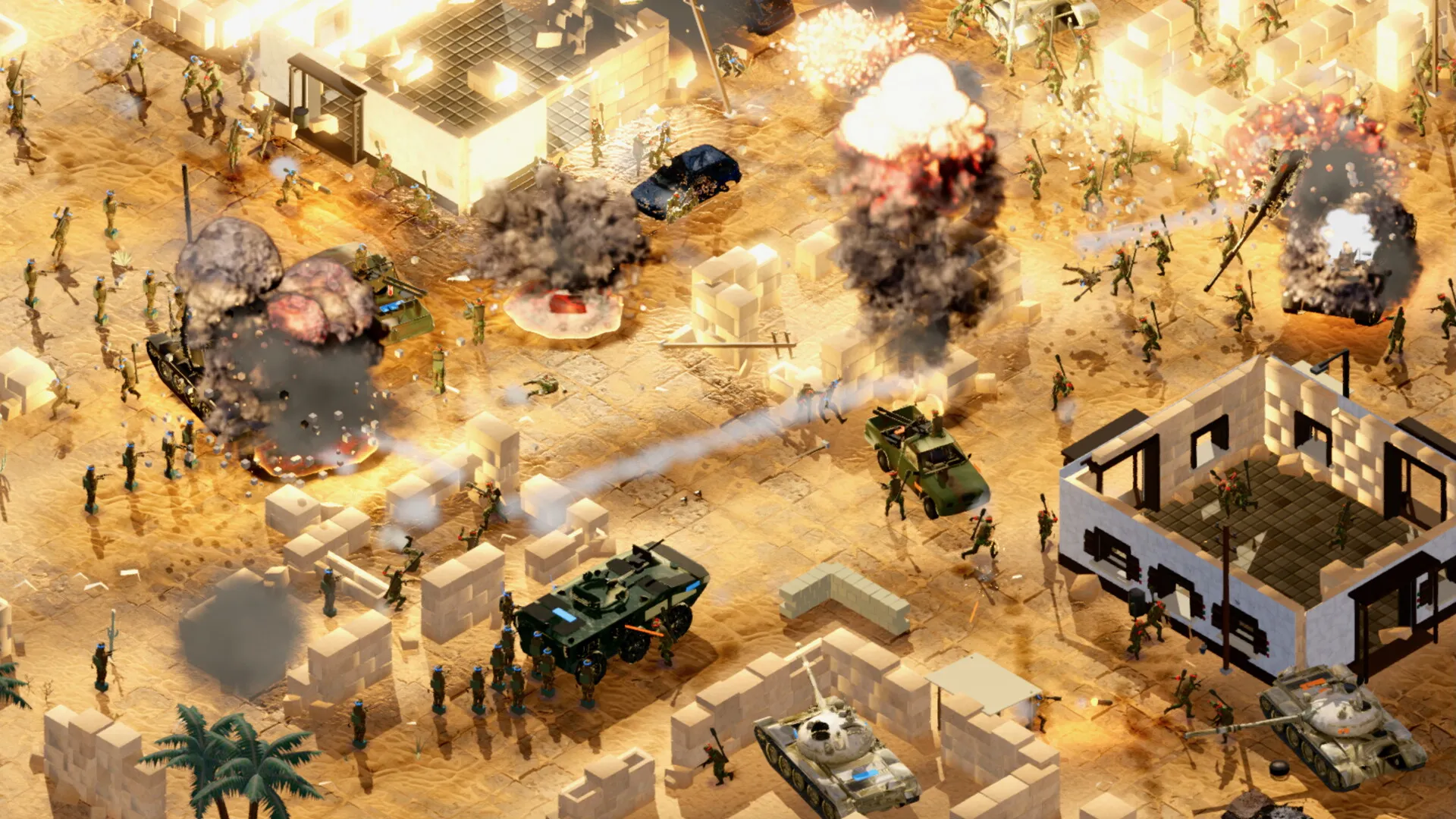
Most RTS games treat cover as a switch: a soldier stands on a crate and receives a damage modifier. Defilade is trying to do something harder. Its soldiers are supposed to read the shape of the ground, choose a posture that fits it, and move between positions without being manually placed.
That changes how you should command them. The question is no longer “which crate gives the best bonus?” It is “which angle do I want the squad to hold, and what can see that angle?”
What the cover AI is confirmed to do
The Steam page and the 22 October update give a concrete list:
- Soldiers use almost any object as cover: walls, corners, trenches, vehicles, standing or fallen trees, wreckage and low obstacles.
- They change posture: standing, kneeling, crouch-walking, prone, crawling, diving and rolling.
- They vault low cover and garrison buildings.
- They blind-fire around corners and from behind cover.
- They dive away from incoming grenades and FPV drone strikes.
- They throw grenades back.
- They fight from the trench wall and around its corners.
- They drag wounded comrades and use rope rescues.
The developer describes the behaviour as a reaction to older RTS infantry that stood in the open beside a cover marker. The animations are motion-captured specifically for walls, corners and trenches. That level of specificity is the strongest evidence that cover is a real system rather than a stat.
Cover is not the same as concealment
This is the most important distinction in the game, and it is also the title.
Cover stops or degrades fire. A wall, a trench lip, a tank hull and a pile of rubble are cover. Concealment stops observation. A camo net, a bush or the far side of a building may hide a soldier without stopping a bullet.
Defilade confirms both. Camo nets hide men from drones. Trees can be used as cover. A building can hide a squad and then become a deathtrap when artillery removes the wall.
A useful way to read any position:
| Question | Why it matters |
|---|---|
| What can shoot at this position? | Cover only helps against the angles it actually blocks. |
| What can see this position? | Drones, elevated infantry and vehicles may observe over the cover. |
| What happens when the cover is destroyed? | Walls, trees and buildings can be removed by fire. |
| Where is the exit? | A good position with one exposed route is a trap. |
| Is the position worth holding? | Cover that does not control an approach is just a safe place to lose the match. |
The geometry problem
Defilade is isometric, which makes cover legible — and deceptive. A wall that looks like it protects a squad from the south may leave it exposed to fire from the east. Rotating the camera with Q and E is not a cosmetic option; it is how you check the third dimension of a position.
The title term matters here. A position in defilade is shielded from enemy observation and fire by terrain or an obstacle. A position in enfilade is exposed to fire along its length. A trench that protects a squad from frontal fire can become an enfilade if the enemy gets a flanking angle down the trench line.
That is why “the AI will find cover” is not enough. The AI can find the wall. It cannot decide that the wall is the wrong wall.
Posture and the cost of movement
Prone is not a free upgrade. A prone soldier is harder to hit but slower to move and may have a narrower field of fire. Crouch-walking is a compromise between speed and profile. Standing offers the best observation and the worst silhouette.
The confirmed postures give you a vocabulary for orders:
- Hold a line: let the squad settle into kneeling or prone behind the cover, with blind fire around the corner.
- Cross open ground: use fire teams, not a single line. One element should be shooting before the other moves.
- Enter a building: expect the squad to switch to close-range posture and clear rooms. Do not artillery the building you are about to occupy unless you are content with the rubble.
- React to a drone: the dive is automatic, but the squad still needs to be dispersed. A cluster of men diving together is still a cluster.
Trench fighting is a different problem
The 22 October update specifically says men fight from the trench wall and around its corners. That implies a trench is not a simple damage-reduction box. It has a firing step, a lip, corners and entrances.
When you occupy a trench:
- Cover the corners. A trench line that runs straight is an enfilade waiting to happen.
- Keep an exit. A trench with one entrance is a grave once the enemy has grenades.
- Put a support weapon on the edge. The update confirms machine guns on the trench edge and bunkers as part of the defensive set.
- Expect the rescue problem. A casualty below the lip has to be lifted out. That is why stretcher teams exist.
Vehicles as cover — and as targets
Infantry can use vehicles as cover. That is a strong combined-arms mechanic: a Bradley or a supply truck can become a moving wall. But a vehicle is also a large, noisy object that attracts anti-tank fire and drones.
The practical rule is to treat a vehicle as temporary cover. If the vehicle explodes, the squad behind it loses its protection and may take the blast. Do not build a permanent position around a hull that can drive away or burn.
What the AI cannot do
The confirmed behaviour is local. It reacts to nearby geometry and threats. It does not know your operational plan. It will not refuse an order because the objective is a deathtrap, and it will not coordinate two squads from different directions unless you do.
That leaves four jobs for the player:
- Choose the axis of advance.
- Set the support-by-fire position.
- Decide when to trade ground for time.
- Notice when the enemy has changed the angle.
How to practise in the demo
Pick a village map and give yourself one squad and one support element. Do not build an army. Instead:
- Put the squad behind a wall and rotate the camera around it. Note which angles are exposed.
- Order an attack move across the street. Watch where the squad chooses to stop.
- Put a trench between the squad and the objective. Watch how the squad enters and uses it.
- Fire a tank shell into the wall. See how the cover changes.
- Wound a soldier in the open and watch the rescue chain.
If those five things behave coherently, the cover system is doing what the store page claims. If the squad stands in the open and plays the animation anyway, the system is cosmetic — and that is worth knowing before 15 December.
For the military definition behind the title, read what defilade means.